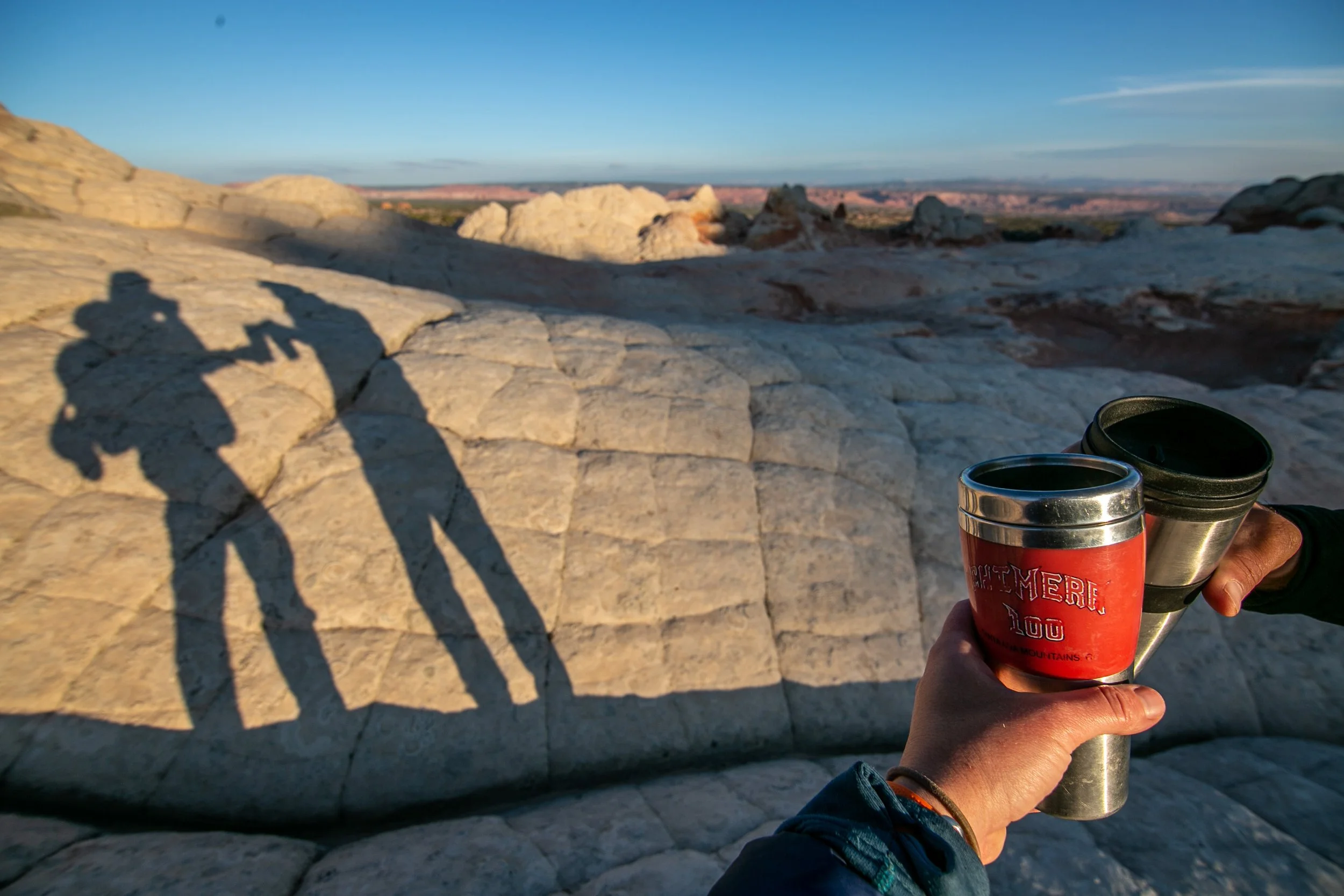
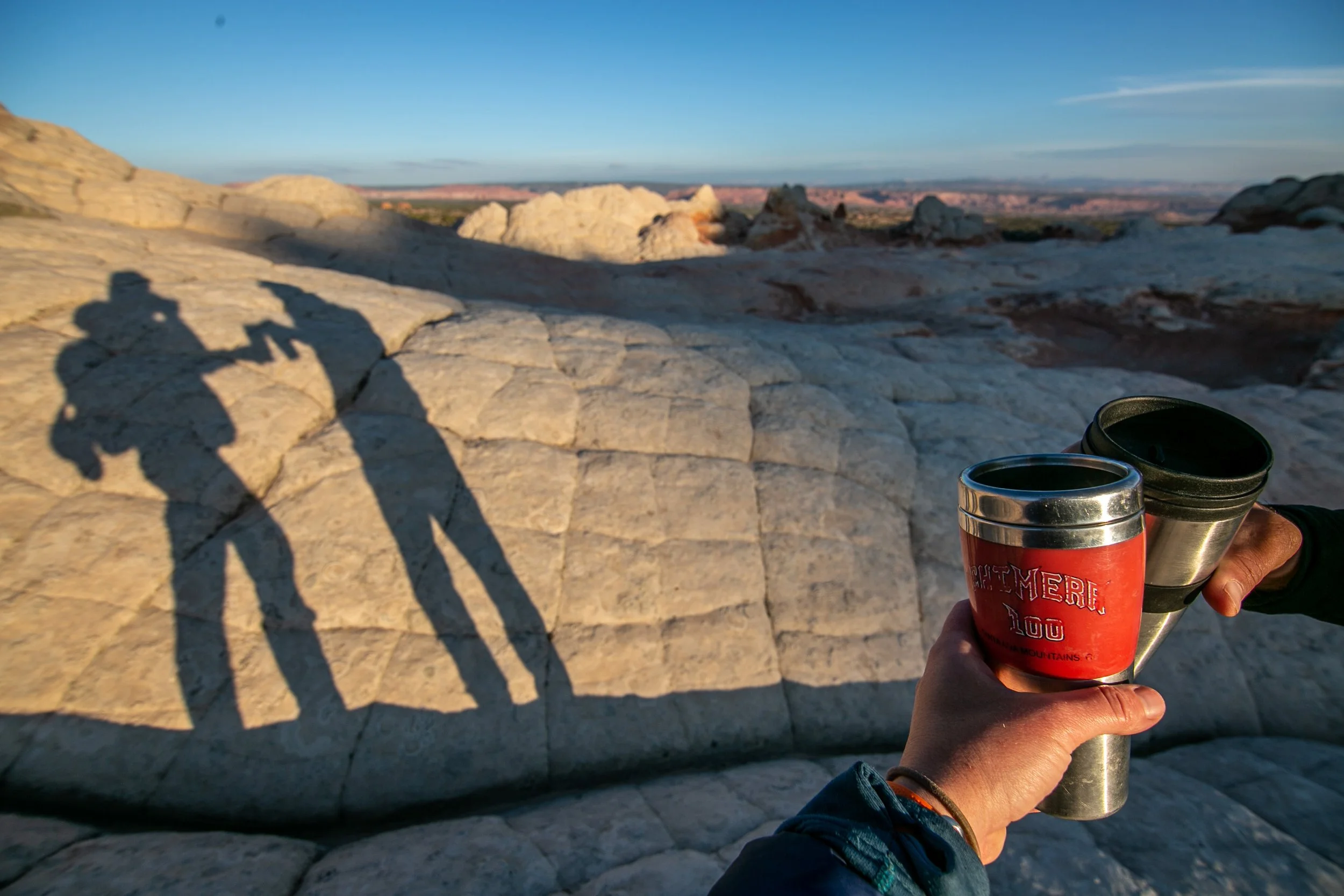
Most of what I’m talking about on this blog is big adventures that have some (but minor) overlap with the businesses that Paul and I run. Today, I want to switch that up a little bit, because I’ve gotten so many questions about White Pocket over the years and it feels like it’s high time for me to share my thoughts on why that spot, in this remote corner of the Vermilion Cliffs, stole my heart and sealed the deal when Paul and I first considered taking over Dreamland Safari Tours in early 2020.
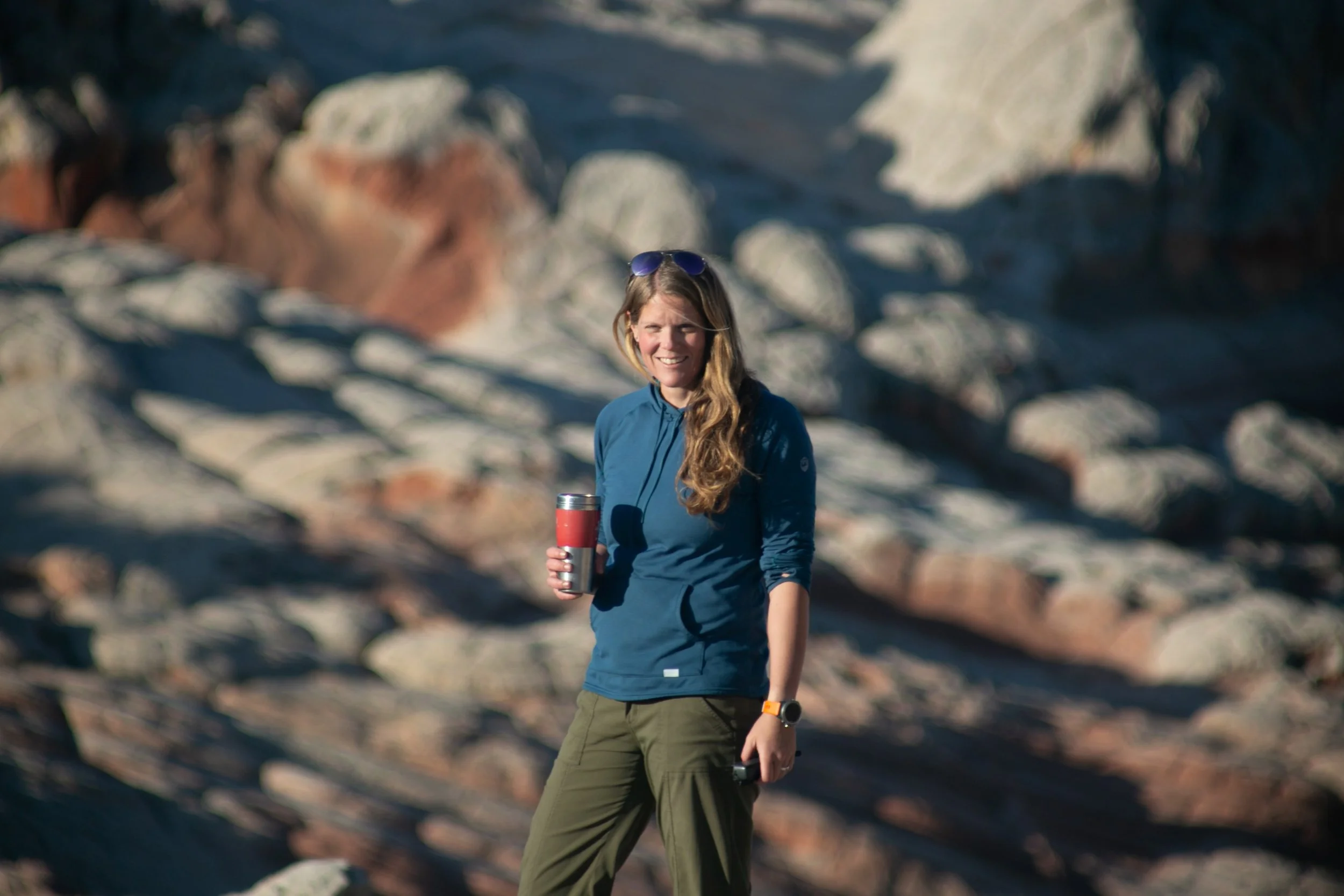
During an early visit to White Pocket (2020)
By now, I've been to White Pocket more than 30 times since Paul and I took over Dreamland six years ago. Some of our senior guides have been out there 300+ times - over a decade of leading trips across the same deep-sand roads to the same 20 acres of rock. You'd think that kind of repetition would dull the place but really… it doesn't. That's the strange thing about White Pocket: it operates on a different logic than most landscapes. Our guides still come back with photos of formations they swear they've never seen before, and after 30-something personal visits I believe them, because it keeps happening to me too. I still pull out my camera or iPhone to take photos everytime I’m out there myself!
So: what makes White Pocket so spectacular, and do you need a guide to visit White Pocket? The answer is: I’ll try to tell you but really - you need to see it for yourself to understand - and, no, you don't need a guide (IF…. you hit a lot of buckets like having a proper 4WD high-clearance vehicle, know how to air down your tires, etc etc).
I'll tell you exactly how to get there yourself, what to watch out for, and when to go. And then I'll tell you why I think most people should seriously consider not doing it alone - which is a conflicted thing to say, given that I run a tour company and have an obvious financial interest in your decision. I'll try to be honest about both sides. You can decide.
So what is it about White Pocket?
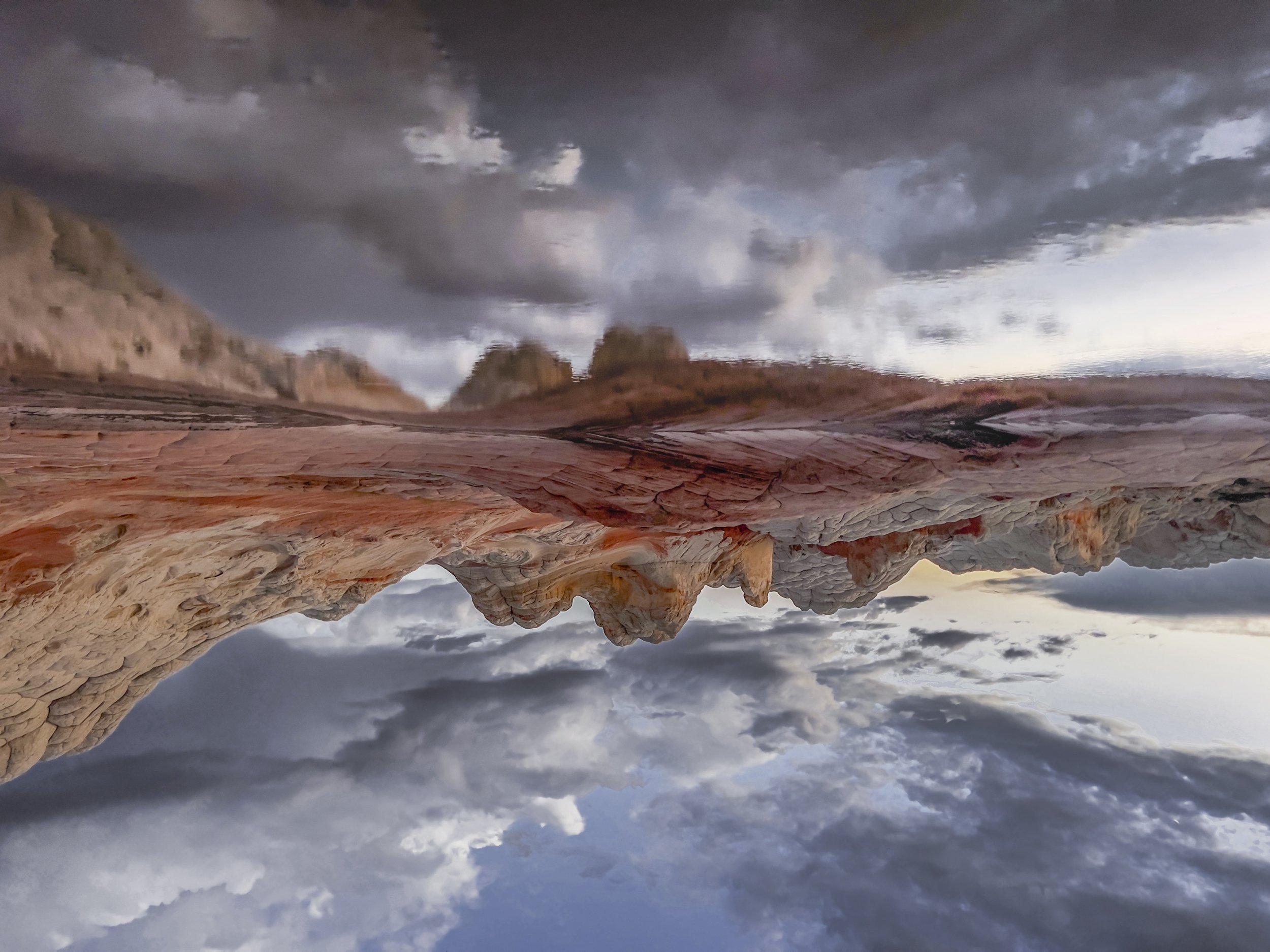
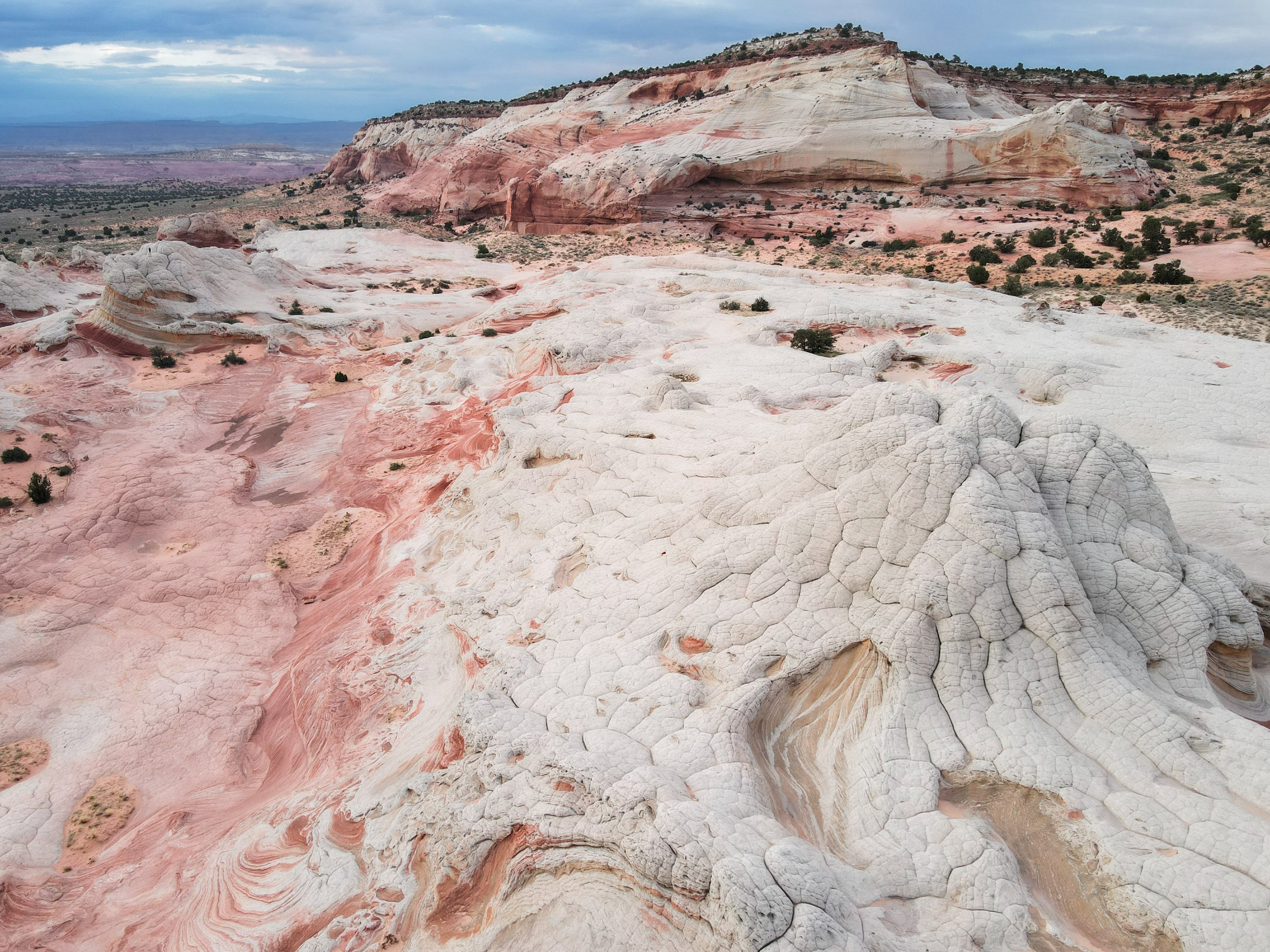
The short version: imagine 20 acres of Navajo Sandstone that looks like it was designed by a fever dream. White polygonal plates - "brain rock" - cracked and tilted at improbable angles. Deep red iron oxide streaks bleeding through white stone like watercolor on wet paper. Swirls that curve into themselves and then just... stop, for no apparent reason. Solution cavities the size of bathtubs carved into rock that's 190 million years old. The whole formation sits on a remote plateau in the Vermilion Cliffs, ringed by the Grand Staircase and the red walls of the Coyote Buttes, and there is no trail. You just walk out onto the rock and start looking. Every time I go, I find something I haven't seen before - a new pocket of color, a micro-arch I walked right past last time, a pattern in the cross-bedding that only shows up when the light hits at a certain angle. It is, genuinely one of the most visually dense landscape I've encountered anywhere - and I've spent a lot of time in a lot of strange places.
The drive is the filter
White Pocket sits on the Paria Plateau in the Vermilion Cliffs National Monument, technically in Arizona but less than three miles from the Utah border. The closest town is Kanab, Utah - our home - and from Kanab the drive takes about two and a half hours each way. Most of that time is spent on dirt roads, and the last stretch is deep sand. Not packed sand, not hard-pan. Loose, rutted, axle-grabbing sand that swallows rental SUVs and spits out tow bills north of a thousand dollars.
This is not an exaggeration. Every year the BLM posts warnings about it. Every year people ignore them. I've personally pulled strangers out of sand pits with our Suburbans more times than I can count, and I've watched recovery trucks make the long haul out to rescue people who got in over their heads. The ones who rented a Jeep Wrangler with aggressive tires usually do fine. The ones who showed up in an AWD crossover because "AWD is basically the same thing, right?" - those are the ones sitting on the side of the road at 3pm wondering how their day went sideways.
Here's the honest assessment: if you have a true 4WD vehicle with decent clearance, if you know how to air down your tires, and if you're comfortable driving in sand, you can absolutely get to White Pocket on your own. No permit required, no fee, no reservation. Just show up and explore. The BLM office in Kanab and the Kanab Visitor Center both have detailed maps and current road condition reports (stop in before you go) and we have a great primer about deep sand driving and the road to White Pocket on the Dreamland website here. A GPS is non-negotiable; cell service is nonexistent out there, and the unsigned intersections all look the same.
If you don't have the right vehicle or the sand-driving experience, hire a guide. I'd say that even if I didn't own a guide company. Getting stuck 90 minutes from pavement with no cell service and no shade is not the kind of adventure story that's fun to tell later.
What you're actually looking at
Most blog posts about White Pocket describe it as "brain rock" or "like another planet" and leave it there. Fair enough - the formations do look like a cross between a coral reef and a CT scan. But the geology is more interesting than the metaphors.
White Pocket is Navajo Sandstone, roughly 190 million years old - the same formation that makes up the Wave at Coyote Buttes North, just 6.5 miles away as the raven flies. Same rock, same age, wildly different outcome. The Wave is smooth, symmetrical, photogenically layered. White Pocket is chaotic; polygonal plates of white rock fractured and tilted at odd angles, streaked through with iron oxide reds and oranges, pockmarked with solution cavities, swirled into patterns that genuinely don't look like they should exist in nature.
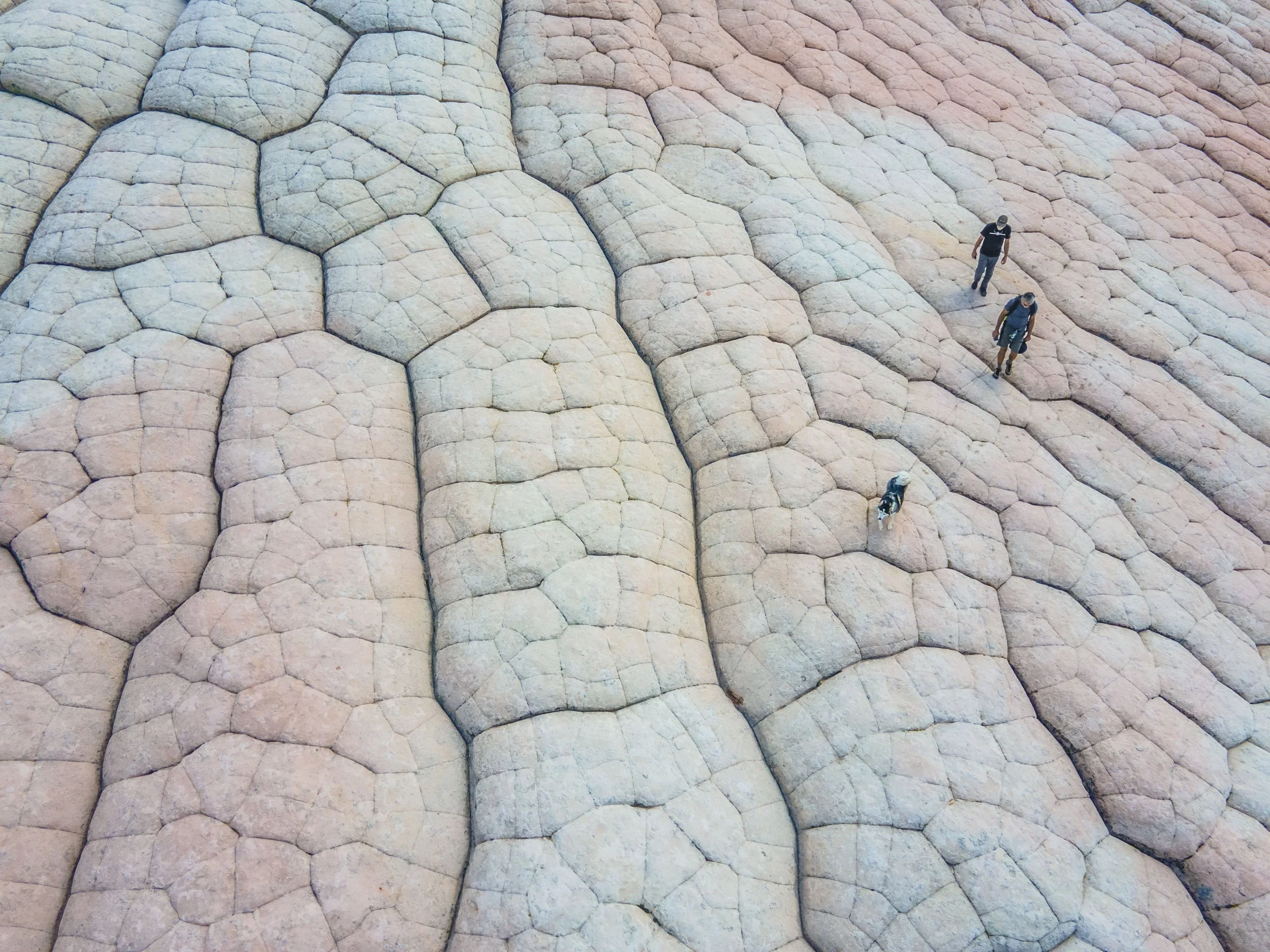
Here's the thing that most visitors don't realize and that I find endlessly interesting: geologists still don't agree on how White Pocket formed. The leading theory involves differential weathering and iron oxide cementation, but the mechanism that produced the polygonal "brain" pattern specifically is still debated. I've listened to geologists argue about it on our tours. I've read the papers. Nobody has a clean answer. For a person who spent her pre-outdoor career in strategy consulting, where every problem was supposed to yield to structured analysis, I find a landscape that resists explanation deeply satisfying. White Pocket doesn't owe us a theory.
The case for going alone
You save money. You set your own schedule. You can camp overnight for free (existing campsites only; pack out everything including human waste) and shoot the Milky Way without coordinating with anyone. The dark skies out there are extraordinary - Bortle Class 2, essentially zero light pollution, the kind of darkness where the galaxy throws shadows. If you're an experienced photographer with your own 4WD rig, a solo overnight at White Pocket might be the single best astrophotography opportunity in the American Southwest.
There's also something to be said for solitude. On a midweek visit in the off-season, you might have the entire 20-acre formation to yourself. No trail, no designated route, no markers. You walk out onto the rock and go wherever curiosity takes you. That kind of unstructured exploration is increasingly rare in the public lands of the Southwest, where even "off the beaten path" destinations are starting to feel managed. White Pocket, for now, still feels genuinely free.
The case for NOT going alone
I'll be transparent: you already know that Paul and I run Dreamland Safari Tours; what you wouldn’t know without me telling you is that White Pocket is one of our most popular trips. So take what follows with appropriate skepticism. But here's what I've observed over years of running these trips:
Most people underexplore it. Without a guide, the average visitor parks, walks onto the first visible formation, takes photos for 45 minutes to an hour, and leaves. They've seen maybe 10% of what's there. Our guides know where the hidden alcoves are, where the best "brain rock" concentrations sit, where the iron oxide striations are most vivid, where to stand at different times of day for the best light. This isn't gatekeeping - it's just pattern recognition built over years. White Pocket is deceptively large and its best features aren't always the most obvious ones.
The drive is stressful if you're not used to it. Sand driving requires a specific skill set and a specific mindset. If you're white-knuckling the steering wheel for 90 minutes in each direction, you arrive at White Pocket already tired and anxious. I've seen this more times than I can count - on my own trips and in stories our guides bring back daily. The people who drove themselves are often checking the time by noon, worrying about the drive back, calculating how much daylight they have left. The people who rode with us are relaxed. They spent the drive looking out the window at the Vermilion Cliffs. They have all day. It's a different experience, and not in a subtle way.
The geology is better with context. This one's subjective, but I believe it. The formations at White Pocket are stunning on their own, but they become genuinely fascinating when someone can explain the iron oxide story, point out the Liesegang bands, show you where the cross-bedding shifts direction and what that implies about 190-million-year-old wind patterns. Our guides are naturalists, not script-readers. They geek out about this stuff because they actually care about it.
When to go
Spring (March through May) and fall (September through November) are the best windows. Summer brings monsoon storms that turn the access roads to impassable mud - and temperatures above 100°F on exposed slickrock with no shade. Winter can work if you don't mind cold; the formations photograph beautifully with low-angle winter light and you'll have the place almost entirely to yourself.
For photography: golden hour (sunrise and sunset) and the two hours surrounding them produce the best light on the formations. Midday sun washes out the subtle color variations in the rock. If you're doing an overnight - whether self-supported or on one of our overnight camping trips - you get both bookend light sessions plus the night sky. It's the reason we started running overnights in the first place; Paul and I camped out there to celebrate our wedding anniversary years ago and realized that a single day visit, however good, only tells half the story.
The honest comparison: White Pocket vs. the Wave
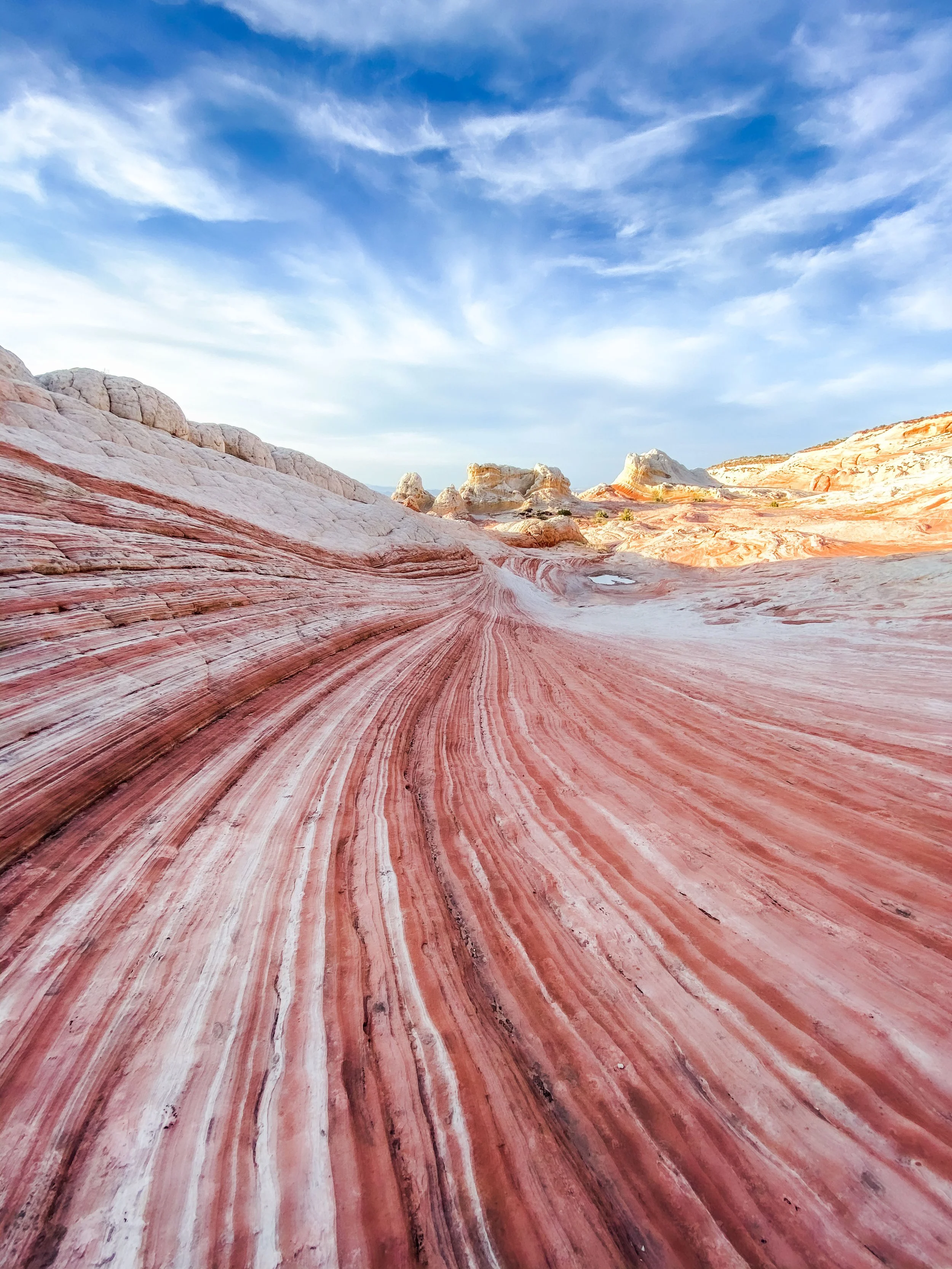
This is White Pocket, but might as well be The Wave!
Everyone asks. Here's how I think about it:
The Wave at Coyote Buttes North is iconic for a reason - it's visually singular, instantly recognizable, and the permit system (a daily lottery limiting visitors to 64 per day) creates genuine scarcity and exclusivity. If you win the lottery, go. It's a 6.5-mile round-trip hike through beautiful terrain to reach a formation that's about an acre in size. The Wave itself is extraordinary. The hike to get there is part of the experience.
White Pocket covers roughly 20 acres - twenty times the area - with a greater variety of formations, colors, and textures. There's no permit required and no lottery. The trade-off is access: instead of a hike, you have a long 4WD drive. Instead of a single iconic formation, you have an entire landscape to explore without trails or markers.
My honest take: if you can only do one, the Wave has the edge for the pure "I can't believe this is real" single-image moment. If you want to actually spend time in a surreal landscape - wander for hours, find your own favorite formation, eat lunch sitting on 190-million-year-old rock - White Pocket is the better experience. They're close enough geographically that you can do both on separate days from Kanab, and I'd recommend exactly that if your schedule allows.
What to bring (self-guided)
A true 4WD vehicle with high clearance. A detailed map from the BLM office or Kanab Visitor Center. A GPS device - not just your phone, which will have no service. A tire pressure gauge and portable air compressor (you'll want to air down to 18-20 PSI for the sand and re-inflate before hitting pavement). More water than you think you need; a gallon per person is the minimum for a day trip. Sun protection - there is no shade at White Pocket. Sturdy shoes with good grip on slickrock. A satellite communicator like a Garmin inReach if you have one; if you don't, at least tell someone your plan and expected return time.
Do not attempt the drive if rain is in the forecast or has fallen recently. The clay and sand mixture becomes genuinely impassable when wet, and getting unstuck will cost you dearly - in dollars, in time, and in dignity.
A closing thought
Paul and I camped at White Pocket for our wedding anniversary. We didn’t choose a resort, or any of the national parks that are in close proximity of Kanab - instead, we decided to spend our anniversary on the slickrock, under the Milky Way, with a camp stove and a bottle of wine and no one else for miles. It's also the first place we take people. Whenever a friend or family member visits Kanab for the first time and asks what they should see, White Pocket is the answer before the question is finished. Not the Grand Canyon, not Zion, not any of the places with entrance fees and visitor centers and gift shops. White Pocket.
I think about why that is sometimes, and I think it's the scale. The Grand Canyon overwhelms you into silence - which is its own gift - but White Pocket invites you to look closely. To get down on your hands and knees and study a Moqui marble with wonder. To notice that the iron streaks change color depending on whether the surface is wet or dry. To find the one small alcove or flower-shaped rock formation that you missed the last 30 times.
The big landscapes get the magazine covers; White Pocket gets our anniversary.